
Schiff Sovereign: Strategic Assets
Gold: $4,100/oz • Silver: $63/oz
Gold Doubled.
This is Next.
Since 2022, Schiff Sovereign’s investment research service, Strategic Assets, has focused on real assets — the metals, energy, food, and transportation an economy actually runs on.
This is the record so far.
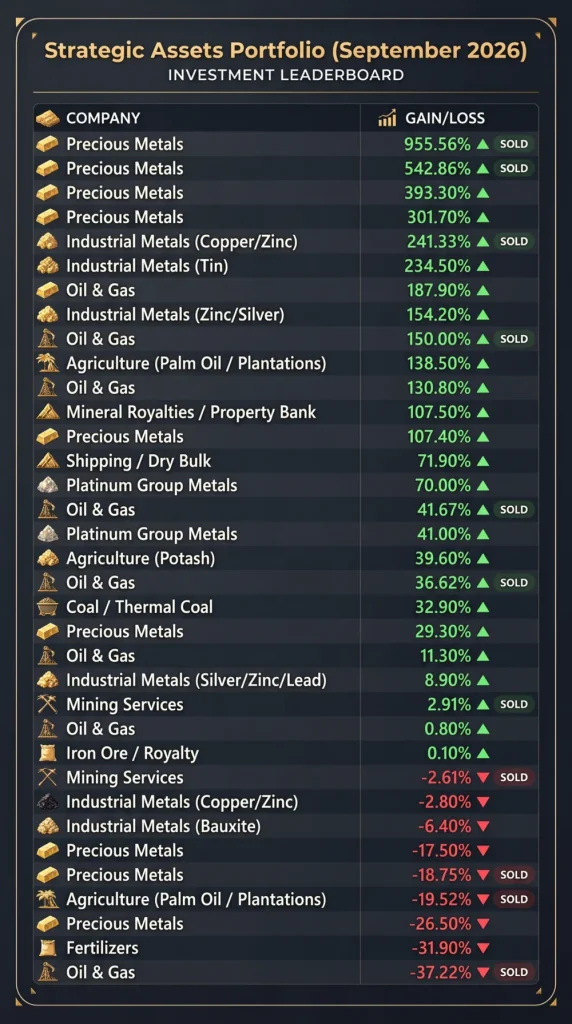
- 172% average return across our 11 closed positions, including losers
- 82% average gain across the 24 positions still open
There’s a reason our three biggest wins have been in precious metals.
In February 2022, after Russia invaded Ukraine, the US and its allies froze roughly $300 billion of the Russian central bank’s reserves.
Every government on earth knew then: dollar savings can be switched off. So they started buying gold, which no other government can freeze, confiscate, or print more of.
A shift of about 2% of global reserves more than doubled the price, from around $1,800 an ounce to over $4,000.
We told our readers this was coming. And the companies we featured — profitable gold producers with little or no debt, trading cheap against the cash they were generating — multiplied as the metal repriced.
Gold isn’t finished. Reserve managers have said they plan to move at least another 7% of their savings out of dollars over the coming decade.
And many gold producers are still cheap — every time gold pulls back even slightly, investors sell the miners as if the story changed, and it hasn’t.
One gold producer we featured has already gone up 5x, yet it’s earning money so fast that the stock is cheaper against those earnings today than the day we wrote it up. It pays a substantial dividend, too.
But it’s hard to deny that the big move already happened.
The next leg is in everything else a country runs on.
Governments that used to trust the system, supply chains, and US leadership are now securing what matters to them directly.
The thesis is simple:
Ukraine was gold. Frozen reserves taught every government on earth not to trust their reserves to dollars or US bonds.
Hormuz is everything else. When Iran closed the Strait of Hormuz this February, a quarter of the world’s seaborne oil vanished from the market. China had already cut off rare earths more than once.
So governments are stockpiling whatever they cannot do without: energy, base metals, rare earths, even memory chips.
And a decade of underinvestment sits under it all. After the last commodity bust, spending on new mines and wells dried up, and it stayed that way for a decade. So there’s no spare capacity to absorb any of this new demand.
Every disruption gets resolved with a higher price — and the companies that own the scarce assets collect the difference.
Silver went first.
Silver follows gold because investors who missed gold’s run buy the cheaper metal that hasn’t had one yet. And on top of that, the world had spent years consuming more silver than its mines produced.
A small silver producer we featured in April 2025, in the middle of the tariff turmoil, rose more than 10x in ten months. That’s the 956% at the top of this page.
Oil is the obvious one.
With the Strait of Hormuz closed, the countries that depended on it are short of oil, and producers outside the region are booming.
A recent issue featured a small South American producer with no debt, cash in the bank, and a price equal to about three years of the cash it’s generating right now. Its fastest well paid for itself in 37 days.
None of that is a bet on the war with Iran lasting. The company is cheap against the oil price that already exists.
Ships are the less obvious one.
There are only so many ships to carry oil. And the world is replacing Gulf barrels with crude hauled from farther away, so every available ship is sailing longer routes.
But we didn’t crowd into shipping when the disruption made it obvious. We bought our shipping companies in 2023 and 2024, when nobody wanted them. Rates had been so bad for so long that owners had stopped ordering new ships, and since a ship takes three years to build and every order is public, we could count exactly how many ships the world would have in 2026… and there weren’t enough.
When the strait closed, the biggest crude carriers went from earning as little as $36,000 a day to nearly $470,000 a day for a single run.
One tanker owner on our list is up more than 188% and just reported the best quarter in its history. Another is up more than 131%.
The industrial metals are following.
Base metals sat through that decade of underinvestment too, and now they’re on the government stockpile lists alongside energy and rare earths.
A zinc producer we featured is up more than 150% in under a year and is now in takeover talks with a much larger rival.
A tin miner is up more than 230% and trading at all-time highs. Tin is crucial for computer chips, and the market is only beginning to realize the metal is in a deficit.
Get Access to Strategic Assets
How a company makes the list
A company gets featured in Strategic Assets only when it is already profitable, carries little or no debt, and trades cheap against the cash it is generating.
Behind that bar sit five criteria:
- Low-cost production
- A rock-solid balance sheet
- Capable leadership
- A cheap price against earnings or asset value
- A catalyst the market hasn’t yet appreciated.
That last one is where the returns come from. For example, the market hadn’t bothered to reprice one small silver producer’s debt restructuring… and that’s what a 956% gain looks like when it noticed.
Every analysis starts with the balance sheet, then works through what the company earns, how cheap the stock is against those earnings, and the risks: commodity price, location, currency.
Every one ends with a buy-up-to price, the level past which the numbers stop making the case. We don’t chase share prices higher.
And don’t be caught in the trap of listening to permabulls who tell you to buy no matter what the price level is.
We are not married to a particular stock or trade, and we are not here to be cheerleaders. When silver turned euphoric this past January, we suggested readers protect their gains; silver peaked two days later and fell 40% in a single session.
What you get every month
Each issue of Strategic Assets delivers:
- The history. Governments have debased currencies, supply lines have snapped, and commodities have run the cycle of shortage and glut for centuries. Every issue opens with the parallel that matters right now.
- The current situation. What’s breaking in the world this month, and who stands to benefit.
- One full company analysis. The balance sheet first, then earnings, the risks, the catalysts, and a buy-up-to price.
- An investment insight you can reuse. How the shipbuilding order book reveals a shortage years in advance, when in a mine’s life to buy it, how to spot a market bottom from what companies do rather than what the price does.
- Updates on every past pick as earnings and news come out.
- The live table. Every stock we’ve ever researched, how it’s done since, and what to do today: hold, buy, or sell.
And markets don’t wait for a publishing schedule. When something needs attention between issues, you hear from us right away — that January note at the top of the silver euphoria went out two days before the peak.
Two more things worth knowing:
- If nothing on our watchlist is at the right price, we won’t say buy just to fill an issue; the worst thing for an investor is having to buy instead of waiting for a real opportunity.
- And we disclose which of these stocks we own — we never trade before an issue goes out, we give notice before we sell, and we take nothing from any company we cover.
My Personal Guarantee

Frequently Asked Questions
What are real assets?
Simply put, real assets are the most important and critical resources in an economy.
They include things like food, energy, essential minerals and metals, certain real estate, and productive technology.
Some people conflate “real assets” with “commodities” and we think that is intellectually lazy.
Certainly some commodities are absolutely critical and provide a vital function.
Oil is an obvious example. Without it, modern civilization doesn’t exist.
Sugar is a commodity too. But let’s be honest, the world would probably do just fine if there were less sugar. Hence, it is not a real asset.
The key question is, does it serve a vital function? If it does, it’s a real asset.
Why are real assets so important right now?
Three things are happening at once, and they all point the same direction.
The first came in 2022. After Russia invaded Ukraine, the US and its allies froze roughly $300 billion of the Russian central bank’s savings, and every government saw that dollar reserves can be switched off. So they bought gold, which no government can freeze or print, and now hold more of it than US government bonds.
The second came in February, when Iran closed the Strait of Hormuz over US and Israeli strikes, and a quarter of the world’s seaborne oil vanished. China had already cut off rare earth exports more than once. So governments are stockpiling what they used to assume they could always buy: energy, base metals, rare earths, even memory chips.
The third sits underneath both. After the last commodity bust, spending on new mines and wells dried up for a decade, leaving no spare capacity for this new demand— and new supply takes years to build.
So every disruption ends up settled with a higher price… and the companies that own these resources collect the difference.
Why is inflation the key consequence of all this government debt?
Throughout human history, governments have “solved” their debt problems by debasing the value of their currencies. In modern terms, that means their central banks create money at an astonishing pace.
Sadly this is far from unprecedented. They have a name for it. It’s called Quantitative Easing.
And this is not just an American habit. The Federal Reserve created $5 trillion of new money during the pandemic, but the European Central Bank and the Bank of England were running their own versions at the same time, and the Bank of Japan bought so many of its own government’s bonds that it ended up owning more than half of them.
The result of all that new money, as you most certainly remember, was the worst bout of inflation in four decades— 9% in the US, and north of 11% in Britain.
Every one of those governments is deeper in debt today than it was then. So if $5 trillion from the Fed alone created 9% inflation, how high will inflation get when the developed world’s central banks have to print tens of trillions to keep their governments funded?
Why are real assets such a great inflation hedge?
Central banks have the power to conjure trillions, or even tens of trillions of dollars, out of thin air.
But they do not have the ability to create a single drop of oil, a single square foot of farmland, a tiny scrap of gold… nor the power to generate ideas and disruptive technology.
It’s simple arithmetic. If a central bank creates trillions of dollars, and floods the economy with all that money, without a concurrent rise in the amount of goods and services that the economy produces, then prices are going to rise dramatically.
The central idea behind this thesis is to own the most important economic resources, i.e. real assets, primarily because they are both scarce, and vital.
Plus history tells us that real assets perform extremely well during inflationary times, as we saw both during the pandemic, and during the stagflation of the 1970s.
What’s the best way to own real assets?
Some real assets, like gold, are easy to buy in physical form.
In most places, it’s straightforward to buy bars and coins. And you can do this with silver, and a number of commodities.
It’s a lot harder to do with others. Good luck ordering a bunch of physical uranium to your house. You’ll probably get a knock at the door from the federal government.
Similarly, it’s hard to own productive technology… you could always buy patents directly, but the market is illiquid and lacks transparency.
In many cases, a far better way to own real assets is to own the companies which produce them.
Why is right now a good time to buy real assets?
While many other assets— the share prices of popular technology companies, for instance— trade at historically high valuations, many real assets and the companies which produce them are still trading at attractive levels.
Relative to financial assets (popular tech stocks and other blue chips), real assets remain near their cheapest levels in a century.
Does Schiff Sovereign’s Strategic Assets focus on real assets?
Yes. This is our core investing ethos. But it’s more than just real assets.
We find extremely high quality, well managed real asset businesses that are already profitable, often paying dividends, and have pristine balance sheets.
They are also NOT mega-cap businesses, so they are often overlooked by mainstream investment analysts.
The idea is that we want to own the best companies in the real asset space that can thrive in any condition.
What do I receive as a subscriber to Schiff Sovereign’s Strategic Assets?
Every month you get a full research issue. Each one opens with history— the moment in the past that mirrors what’s happening in real assets today— then moves to what’s breaking in the world right now, and which companies stand to benefit.
The heart of it is one complete analysis of a business that meets our criteria: the balance sheet first, then what the company earns, how cheap the stock is against those earnings, the risks, and the catalysts the market hasn’t appreciated yet.
Every analysis ends with a buy-up-to price, the level past which the numbers no longer make the case. You’ll also come away with something you can use on your own, like knowing when in a mine’s life is the right moment to buy it.
Then there are updates on the companies we’ve already featured, the full archive the day you join, and the live table— every stock we’ve ever researched, what it’s done since, and what to do about it today: buy, hold, or sell.
And markets don’t wait for a publishing schedule. When something needs attention between issues, you hear from us right away.
Where are all of these stocks listed?
We are not geographically constrained because we look for the best value and that is often found outside the United States. The companies we feature include listings in London, Toronto, and Sydney as well as in New York. Part of the reason they’re so cheap is that most American investors never look there.
And that’s far less of a hurdle than it sounds. Many brokers are set up for international trading, and all of our featured companies are available through a full service broker such as Interactive Brokers.
How long do I need to hold these investments?
Our goal is to look for investments that will work on a 6 to 18 month basis.
That means we are not chasing our tail looking for whatever happens to be the flavor of the month. But it also means we are not looking for companies where you’ll need to sit on your hands for five or ten years waiting for a thesis to work.
What if I don’t like it, or decide it’s not for me?
No problem, we’re not interested in keeping anyone’s money if they aren’t satisfied with our research and strategy.
We have an iron-clad 30-day money back guarantee if you’re not satisfied for any reason.
Ready to become a Member of Strategic Assets ?
Try Schiff Sovereign: Strategic Assets risk-free with our 100% Money Back Guarantee.
Strategic Assets is $99 a month, or $995 a year — two months free. Cancel anytime.
And it comes with a guarantee: for thirty days, for any reason, you can get a full refund.
Yes, we know that means you could see the current issue, the full archive, and the live table for free. We don’t care. We’re confident that what you get month after month will make staying a no-brainer.
The thesis hasn’t changed since 2022, and it shows no sign of changing now. The government hasn’t stopped printing, the world hasn’t gotten friendlier, and new supply takes years to build.
Real assets are waking up… but this is still early innings.
PLEASE NOTE:
You are fully protected by our 30 day no-questions-asked 100% money back guarantee.
If you take advantage of this monthly offer, you’ll be charged $99 or $995 today and your Schiff Sovereign: Strategic Assets membership will renew automatically every month or year respectively.
You can cancel the automatic renewal at any time. Simply send us an email to [email protected].
And your membership renewals are also protected by the same 30 day no-questions-asked 100% money back guarantee.
Schiff Sovereign: Strategic Assets provides independent research which should not be viewed as investment or tax advice, nor an offer to purchase securities.
Legal Disclaimer: Neither this document, nor any content presented by our organization, is intended to provide personal tax or financial advice.
This information is intended to be used and must be used for information purposes only. We are not investment or tax advisors, and this should not be considered advice.
It is very important to do your own analysis before making any investment or employing any tax strategy. You should consider your own personal circumstances and speak with professional advisors before making any investment.
The information contained in this report is based on our own research, opinions, as well as representations made by company management.
We believe the information presented in this report to be true and accurate at the time of publication, but do not guarantee the accuracy of every statement, nor guarantee that the information will not change in the future. It is important that you independently research any information that you wish to rely upon, whether for the purpose of making an investment or tax decision, or otherwise.
No content on the website (SchiffSovereign.com) or related sites, nor any content in this report or related content, constitutes, nor should be understood as constituting, a recommendation to enter into any securities transactions or to engage in any of the investment strategies presented here, nor an offer of securities.
We believe in eating our own cooking, therefore Schiff Sovereign employees, officers, and directors may participate in any investment described in this content when legally permissible. Any existing or future positions will be disclosed, and no position will be disposed of without providing at least seven days’ notice to readers. Such notice will also provide an update on our analysts’ reasoning and outlook on the company.
Schiff Sovereign employees, officers, directors, and related parties receive NO fees, commissions, or any compensation whatsoever from any companies which appear in this report. All research is based on our independent analysis, and our only incentive is to provide the best possible research for our audience.
